

A Charlotte home tells you more than the thermostat does. The screen may say 72 degrees, the vents may still blow, and the room may feel cooler than it did an hour ago, but a bedroom can still smell stale even with the door closed. A closet can trap damp odors from stored clothes, shoes, or cardboard. A white ceiling register can start to show a gray-brown ring around the edge, even though the AC sounds like it is running all day.
At MasterTech, we pay attention to that difference because a cool house is not always a dry house. Fan-only AC mode matters because it keeps the HVAC fan running after active cooling stops, ensuring the home continues to get air movement without the same moisture removal. For mold inspection Charlotte NC, homeowners can use it as a practical first step; the question is not only whether mold is visible. The better question is whether the house is moving moisture through bedrooms, closets, vents, crawl-space-influenced areas, and low-airflow rooms after the system has stopped drying the air.
The confusing part is that the system sounds active. Air comes through the vents, the thermostat reaches the set temperature, and the home feels cooler than it did earlier in the day. The problem is that temperature control and moisture control are not the same result. The U.S. Department of Energy explains that in hot, humid climates, air conditioning must lower both indoor air temperature and indoor humidity, as indoor air may still feel damp even when it is cool.
That matters in Charlotte because local moisture conditions are shaped by the region’s inland Piedmont climate. Homes may still experience humid summer air, moisture near lakes, vented crawl spaces, shaded rooms, and uneven airflow from room to room.
When a homeowner calls about a house that feels cool but damp, the complaint usually sounds specific before it sounds technical. These are the kinds of clues that matter because they show where moisture is appearing, not just whether the thermostat is set low enough.
Those details point to moisture behavior inside the house. They do not prove mold on their own, and they should not be treated as a final diagnosis. They do tell us where to look more closely because moisture problems usually leave patterns before they leave obvious damage. A damp bedroom, a stained register, and a fan set to “On” tell a clearer story together than any one clue tells alone.
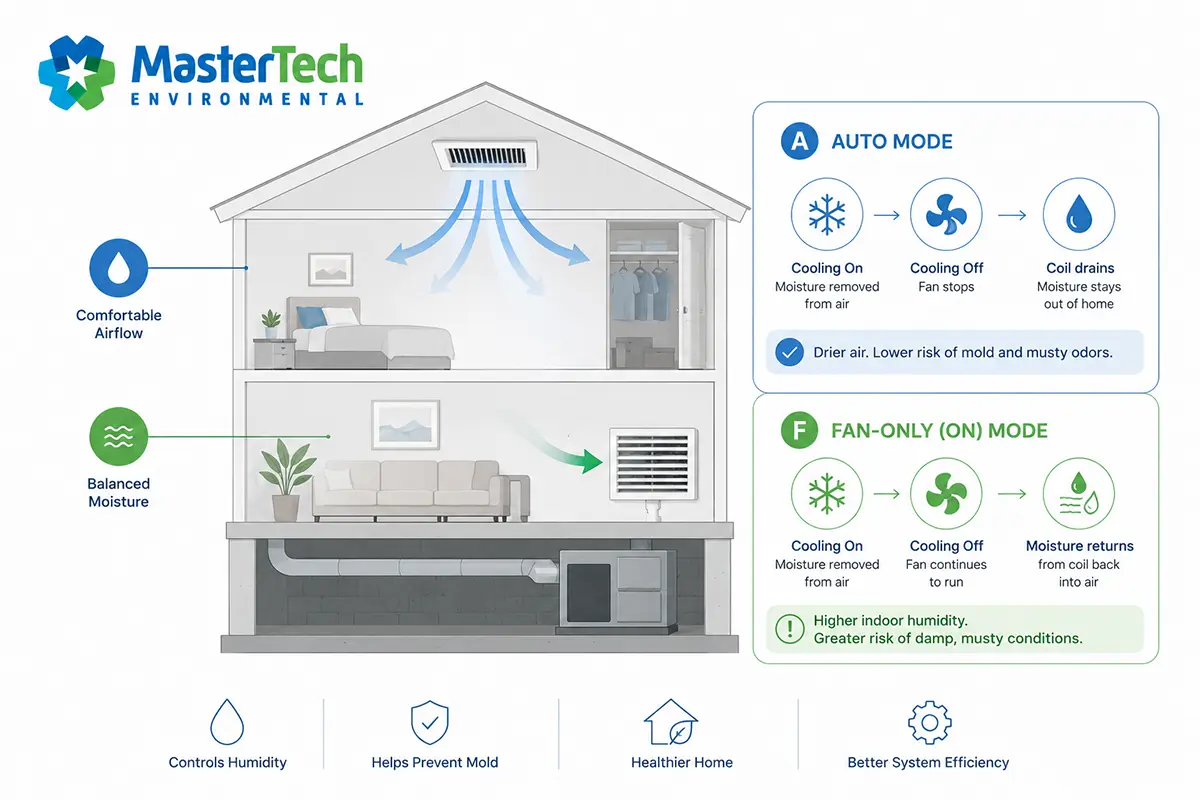
During active cooling, humid indoor air passes across the cold evaporator coil inside the HVAC system. Moisture leaves the air, collects on the coil, and drains away through the system. That is the drying part of air conditioning, and it only works properly when the system has time to remove water from the air and drain it out. When the compressor shuts off, the coil does not dry out at the same time.
The fan setting becomes important after the compressor stops. Oak Ridge National Laboratory and Lawrence Berkeley National Laboratory modeled residential AC moisture behavior and specifically tracked moisture left on the cooling coil. Their model allowed water left on the coil to re-evaporate when the blower ran while cooling was off. That provides a technical explanation for why fan-only mode creates a moisture issue rather than a harmless comfort setting.
Newer research supports the same concern. A 2024 National Renewable Energy Laboratory report states that continuous fan-only circulation is not recommended because it increases indoor humidity by evaporating water from the wet coil back into the airstream. The report also notes that periodic fan-only operation during the cooling season can increase indoor humidity, which is why off-cycle ventilation should be minimized.
| Thermostat Fan Setting | What the Homeowner Hears | What the System Is Doing | Why It Matters |
| Auto | Air starts and stops with cooling | The fan runs during active cooling and shuts off when the cooling call ends | Water on the coil has more time to drain out of the system |
| On | Air keeps moving through the vents | The fan keeps running after active cooling stops | Air moves across a wet coil and may carry moisture back into the home |
The table matters because both settings create airflow, but only one keeps the fan tied to the drying cycle. A homeowner hears air moving in both cases, so the system may seem active either way. The moisture behavior is different because “On” keeps the blower moving air after active cooling has ended. That is why a home can sound like the AC is helping while bedrooms, closets, and vent areas still feel damp.
Fan-only mode feels reasonable because a moving room feels less still. That does not mean the room is drying out. Air movement changes how the room feels in the moment, while moisture removal changes the condition of the indoor air. Those two things get confused because both involve the HVAC system and both affect comfort.
University of Georgia Extension gives homeowners a direct version of the same advice. It recommends using a well-maintained, appropriately sized air conditioner on the “auto fan” setting and warns that the constant fan setting can reintroduce moisture into the home. That point lines up with what we look for at MasterTech when a Charlotte homeowner says the home is cool, the fan runs often, and the same rooms still feel stale. The fan setting does not explain every moisture concern, but it belongs near the top of the checklist.
Charlotte homes face moisture risks related to warm-season humidity, nearby lakes, crawl-space conditions, shaded rooms, older construction, and HVAC behavior. These local conditions should guide how moisture problems are investigated and explained.
NOAA’s Charlotte/Douglas climate data provides a real number for the local moisture claim. The 1991 to 2020 normals show a normal July mean dew point of 69.5 degrees Fahrenheit, and NOAA defines dew point as the temperature air must be cooled to before reaching 100 percent relative humidity. For a homeowner, the practical point is direct: higher dew point means the air already holds more moisture before the HVAC system has to manage it. Charlotte does not need a coastline to place real moisture pressure on a home during the summer.
That local pressure shows up differently from house to house. A home near Lake Norman or Lake Wylie may deal with warm-month humidity near the water. A home in an established Charlotte neighborhood may have a vented crawl space adding moisture influence from below. A shaded bedroom, closed closet, or room over a crawl space may stay stale longer than the main living area. Fan-only mode sits on top of those conditions by keeping air moving through the home after active drying stops.
At MasterTech, Fred’s mechanical engineering background shapes the way our team thinks about these problems. A damp-house complaint is not one smell, one stain, or one sample. It is a pattern involving the HVAC cycle, moisture readings, visible conditions, room layout, and where symptoms repeat. MasterTech Charlotte’s inspection process reflects that same approach through visual inspection, thermal imaging, moisture mapping, testing when useful, written reports, and consultation.
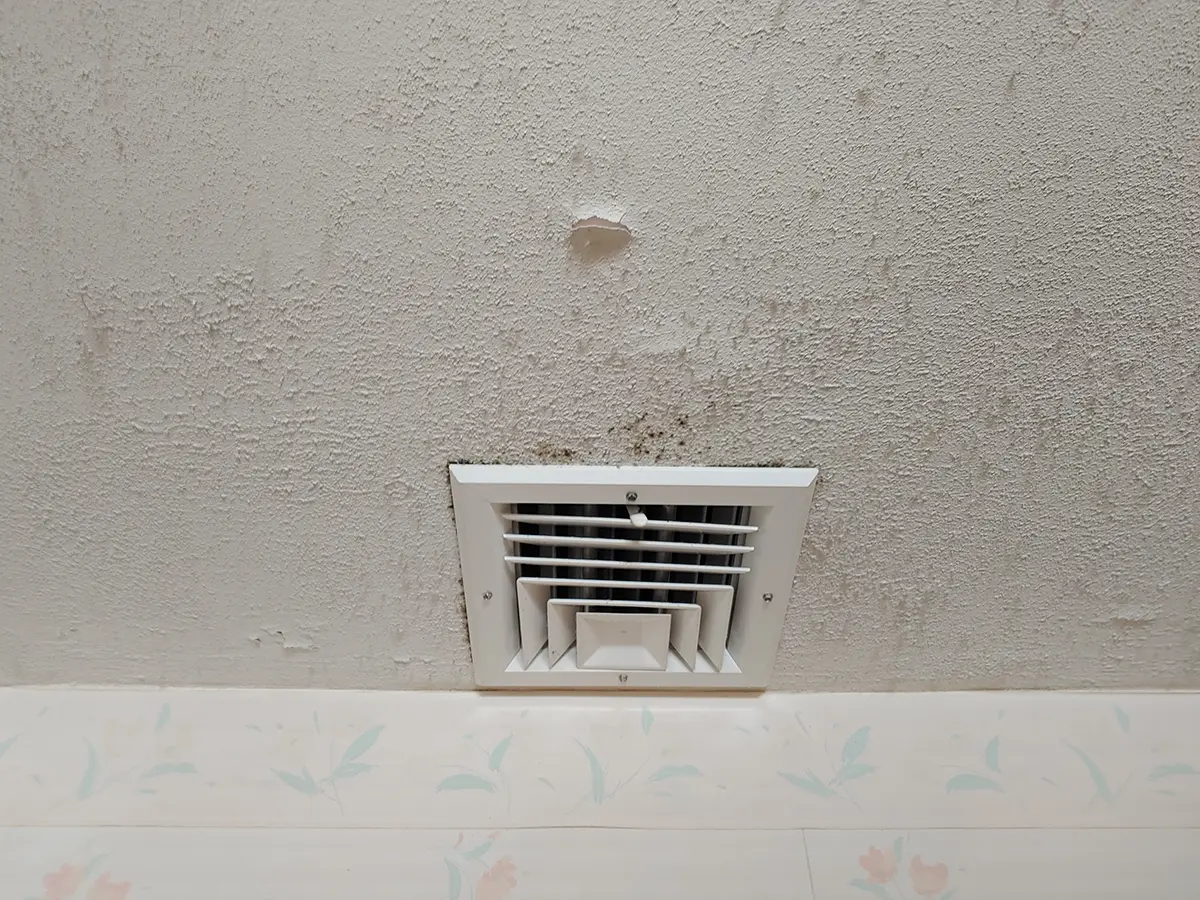
The first warning signs usually appear where moisture, cool surfaces, and limited airflow meet. A vent ring may darken before the homeowner sees anything on a wall. A closet may smell stale because the door stays closed and air does not return well from the space. A bedroom may feel damp in the morning, even though the hallway feels normal.
These clues deserve attention because they point to locations, not vague discomfort. Use them to decide whether the fan setting was part of the issue and whether the same moisture pattern keeps returning.
| What You Notice | What It Suggests |
| Gray or brown ring around a ceiling supply register | Moisture and dust collecting where supply air meets the ceiling surface |
| Musty odor in a closed bedroom | Humidity lingering in a low-airflow room |
| Stale closet smell around stored items | Moisture held in an enclosed space with limited air movement |
| Damp carpet edge near a floor register | Moisture collecting near supply air and flooring material |
| Odor stronger when the fan runs | Air movement carrying a smell from a damp area or HVAC pathway |
These signs do not mean fan-only mode is the only problem. They mean the home is showing you where moisture is active. That distinction matters because a real mold inspection Charlotte NC homeowners rely on should not start by assuming the worst. It should start by reading the house: which rooms feel damp, which vents show staining, when the odor appears, what the fan is doing, and whether the same clues return after the simple settings are corrected.
Start with the thermostat fan setting. Move the fan from “On” to “Auto” so it runs with the cooling cycle instead of continuously between cycles. Then watch the same rooms for several days of similar weather. One hour is not enough time for the home to show whether the moisture pattern has changed.
Use a ceiling fan or portable fan when people need more air movement in a room. That moves air inside the occupied space without forcing the HVAC system to circulate air across a wet coil between cooling cycles. This keeps comfort airflow separate from the AC system’s moisture-removal cycle. It also helps the homeowner avoid mistaking constant vent airflow for actual drying.
The next step is to monitor the areas where the symptoms first appeared. EPA homeowner guidance keeps the mold connection practical by saying moisture control is the key to mold control, and it recommends keeping indoor relative humidity below 60 percent, ideally between 30 and 50 percent. If the bedroom odor fades, the closet smells cleaner, and the vent area stays dry after the fan is set to Auto, the setting was likely part of the humidity pattern. If the same clues return, the home is still holding moisture somewhere.
A Charlotte home can reach the thermostat setting and still have a moisture problem. That is the central point. Fan-only AC mode matters because it keeps air moving after active cooling stops, which may return wet-coil moisture to the airstream and keep dampness active in rooms, closets, vents, and crawl-space-influenced areas. In Charlotte, that matters because summer dew point, lake-area humidity, vented crawl spaces, shaded rooms, and uneven airflow all reduce the home’s margin for moisture mistakes.
The first move is simple: set the HVAC fan to “Auto,” use room fans for comfort, and watch the same problem areas over several days. If the musty bedroom, stale closet, damp carpet edge, or stained supply register improves, the fan setting was likely contributing to the problem. If those signs persist, the issue warrants a closer look, as moisture is still collecting somewhere in the house. That is where mold inspection Charlotte NC should focus: not on guessing from one stain, but on understanding why a cool home is still not drying.