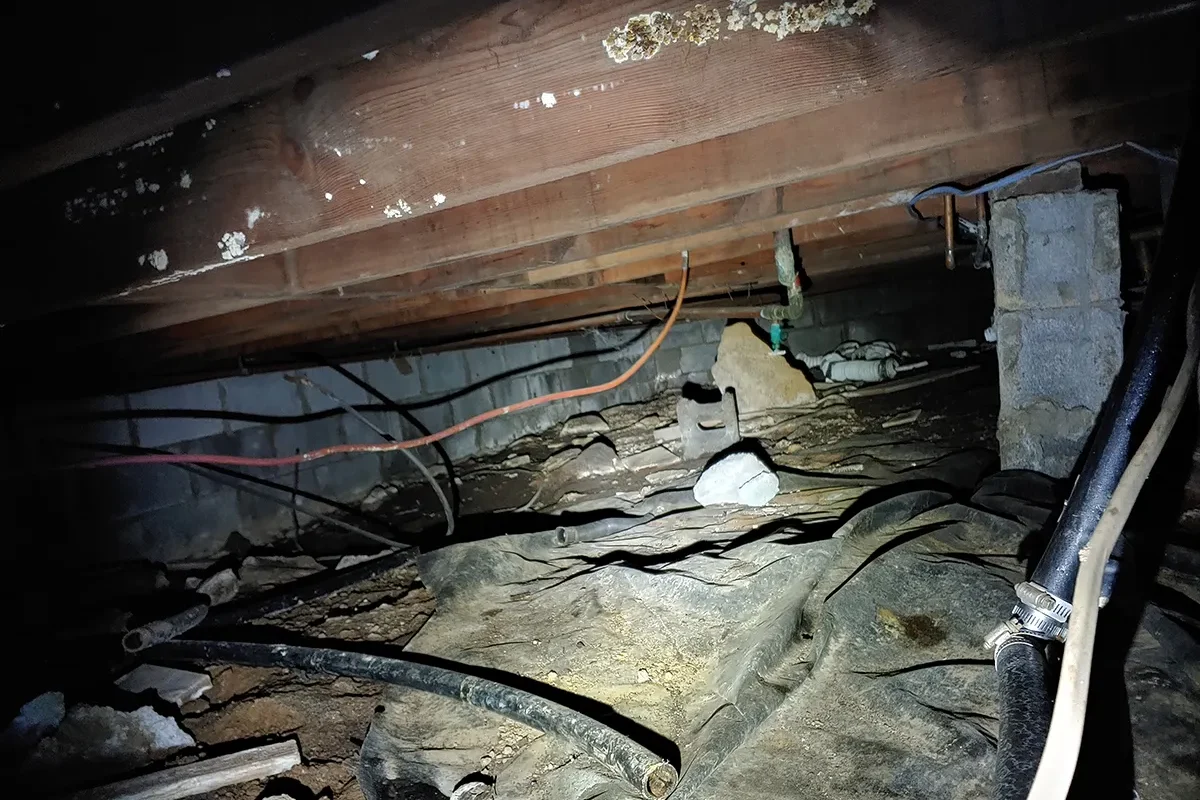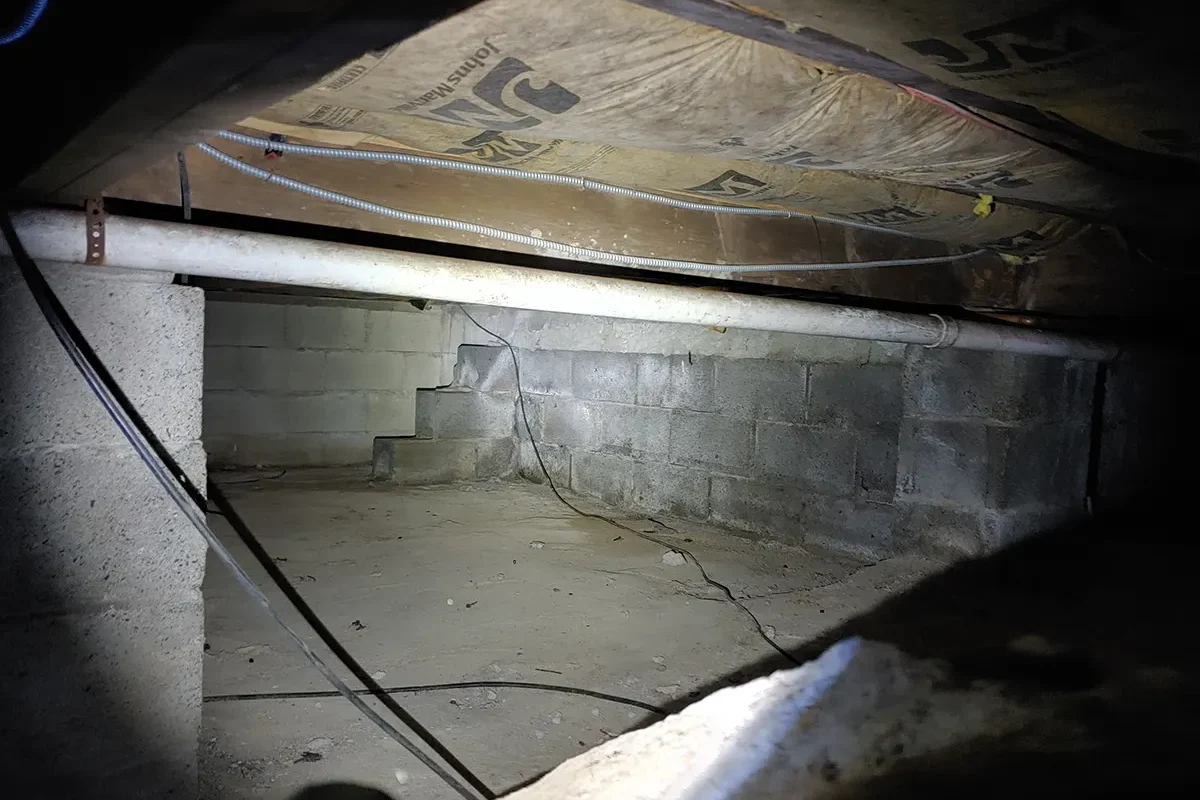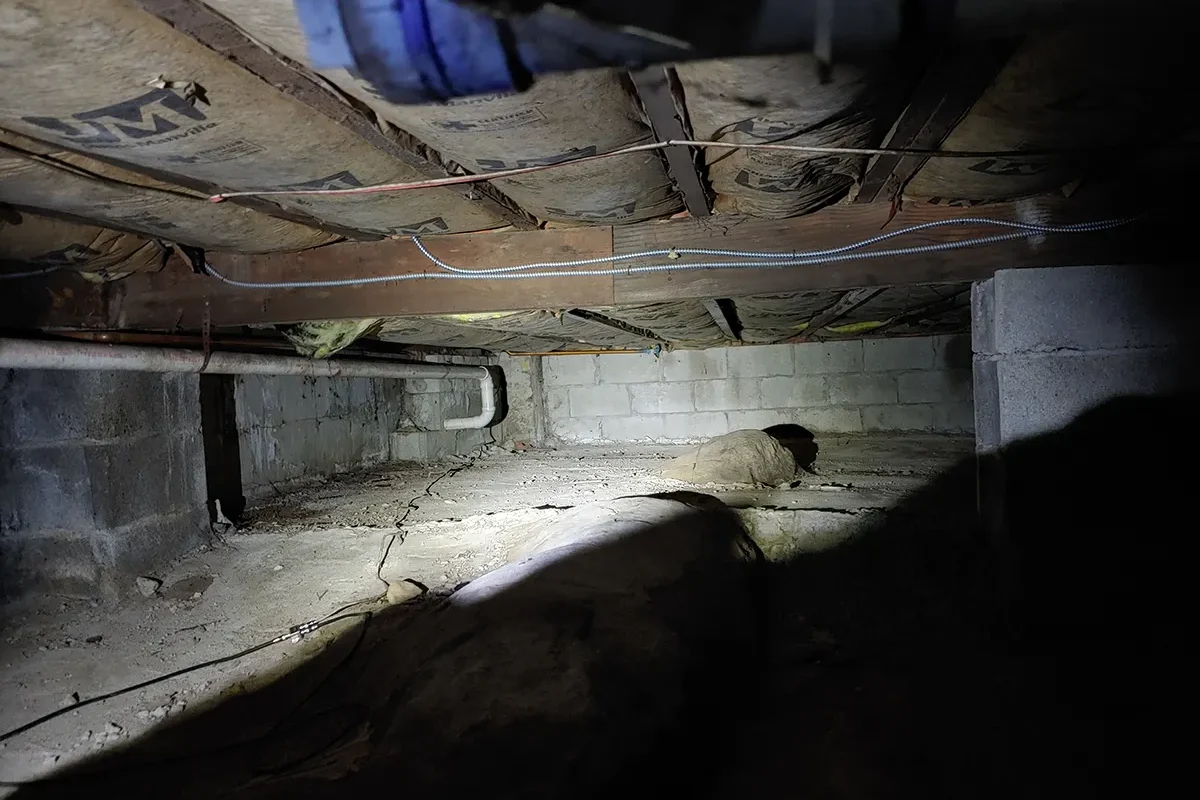
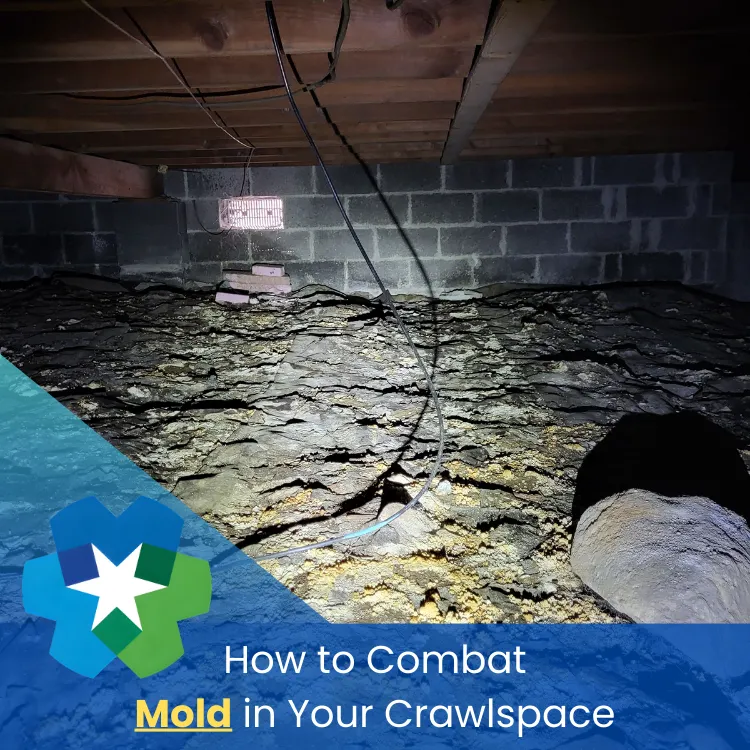
If your crawl space keeps smelling musty, or you keep spotting growth on joists or insulation, it wears you down fast. Most people are not looking for a lecture; they want the problem to stop coming back, and they want to know they are not being sold a random “treatment” that does nothing.
MasterTech Charlotte approaches crawl space mold as a moisture-driver problem first, and a controlled removal and drying job second. The first goal is to identify and confirm what is keeping the space damp, using observable conditions and measurements, then correct that driver so regrowth is not predictable. Only after that do you remove and clean the affected materials, using containment and dust control to prevent contamination from spreading into the rest of the home.
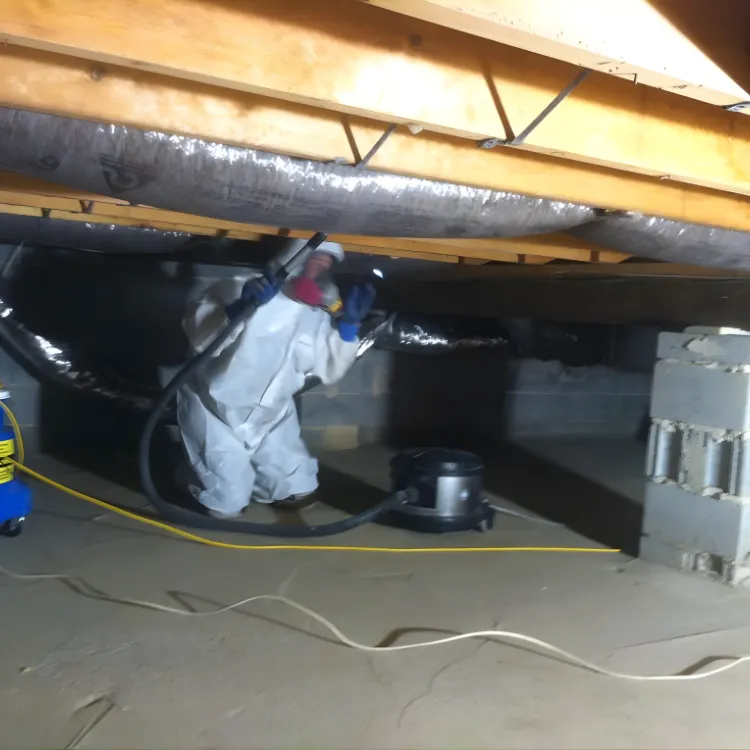
Mold in a crawl space is a sign of dampness.
A dampness signal means structural wood, subflooring, insulation, or stored materials have remained wet long enough, or are being re-wetted repeatedly, to support growth because the underlying moisture source has not been identified and corrected, consistent with North Carolina guidance that moisture must be found and fixed for cleanup to hold and federal guidance that any indoor mold indicates a water problem that must be addressed.
Cleaning alone does not change that signal because surface treatment does not remove the conditions that keep materials damp, and when those materials repeatedly reach their dew point, defined as the temperature at which air moisture condenses on a surface, the same moisture cycle continues and supports new growth.
Once mold is identified, it is essential to reach out for the best crawl space mold remediation Charlotte has to offer. We are happy to answer that call.
Ground-driven moisture rarely announces itself dramatically. There is no obvious leak, no burst pipe. What you notice instead is that the entire crawl space feels heavy. Odor is strongest after rain. Framing across large sections shows mild but consistent staining rather than one isolated bloom.
This pattern tells you the moisture source is broad, not localized. Soil continuously releases vapor. When vapor barrier coverage is partial, torn, or not sealed to walls and piers, it loads the air space. Over time, humidity rises. Wood framing absorbs that moisture. Dust on those surfaces becomes the nutrient base. The issue is not one event. It is a sustained vapor drive.
Confirmation requires looking at coverage percentage and seam integrity, not just whether plastic is present. Relative humidity readings are taken at framing height and compared to exterior conditions. If humidity remains elevated in dry weather and across most of the crawl space, and no plumbing leak is present, the pattern supports ground vapor as the primary driver.
That is not a cleaning problem. It is a moisture barrier problem.
Plumbing-related crawl space mold usually presents as a defined footprint. Growth is tight to a pipe run. Insulation beneath that run feels heavier. Corrosion may appear at one fitting while the rest of the crawl space looks normal.
This is not a humidity problem. It is a repetition problem. A slow drip, even one that evaporates before pooling, keeps the same section of framing cycling between damp and partially dry. That cycling prevents the material from ever stabilizing. Over weeks or months, that damp cycle supports growth.
The confirmation step is about pattern matching. Pipe runs are traced from fixtures above. Joints are inspected. Moisture readings are taken directly beneath the suspected leak and then several feet away in unaffected areas. When elevated readings align with the plumbing path and normalize outside that path, the source is clear.
Surface cleaning in that situation does nothing if the joint continues to seep.
In the cooling season, ducts in a humid crawl space can become cold enough for condensation to form. The growth pattern here is often linear, directly under duct runs. You may see rust streaks or wet strap points before you see visible mold.
The mechanism is simple. When the duct surface temperature drops below the dew point of the surrounding air, moisture condenses on the metal. That moisture drips onto framing and insulation. It may not look like a leak. It may not even pool. But it repeats every time the system runs under the same conditions.
Confirmation is not guesswork. Duct surface temperature is compared to crawl space humidity. Insulation continuity is inspected. Condensate lines are checked for proper slope and discharge. If condensation risk exists and growth aligns with duct placement, the pattern supports HVAC-driven moisture.
Cleaning the joist does not change the physics of condensation.
Sometimes the crawl space mold is not coming from water sitting below. It is coming from air moving through the wrong places.
You enter the crawl space, and the air feels active. You notice open plumbing chases. Gaps around wiring penetrations. Loose subfloor seams. The musty odor is stronger near those openings than near the soil. That pattern matters.
Air carries moisture faster than vapor diffusion through materials. If the home above is under negative pressure relative to the crawl space, humid crawl-space air is pulled upward into the framing cavities. That airflow repeatedly loads moisture into wood surfaces that would otherwise stay stable. The growth pattern often follows framing lines that sit directly beneath penetrations.
Confirmation requires observing airflow direction and pressure imbalance, not guessing. A simple smoke indicator at the access hatch or penetration can show direction. If air consistently pulls upward through the floor assembly, the crawl space is influencing the living space. Humidity readings from the crawl space and the interior help confirm whether the crawl space is acting as a moisture source.
In this scenario, cleaning framing does not change the pressure dynamics that keep pulling humid air upward.
Exterior conditions can quietly control crawl space moisture.
After rainfall, you may notice that the soil near the foundation remains damp longer than the surrounding areas. Downspouts discharge directly beside the crawl space wall. The grade slopes subtly toward the house. Inside, the growth pattern is heavier along the perimeter framing than in the center of the space.
Bulk water increases soil moisture at the foundation line. That moisture migrates inward. Even without visible standing water inside the crawl space, perimeter framing absorbs elevated moisture over time. The issue is not a single storm. It is repeated saturation at the foundation boundary.
Confirmation requires stepping outside. You check downspout extensions. You assess the slope away from the structure. If grading does not direct water at least several feet away, moisture pressure against the foundation increases. When interior staining aligns with exterior drainage failure, the pattern is consistent.
No amount of interior cleaning offsets water repeatedly directed toward the structure.
Sometimes the moisture problem is historical.
You see a water line on a pier or foundation wall. Subfloor sheathing shows slight warping in one area. Insulation appears to have been replaced in patches, but the framing above it shows staining. The homeowner may mention a past plumbing failure or storm event that was “cleaned up.”
Water damage that is not dried to stable moisture levels can leave materials above equilibrium moisture content for extended periods. Even if the surface feels dry, internal moisture may remain elevated. That retained moisture supports delayed growth weeks or months after the visible event.
Confirmation requires measurement, not assumption. Moisture readings are taken on framing in the suspected event area and compared to unaffected sections. If those readings remain elevated relative to surrounding wood long after the event, the space was not dried to a stable endpoint.
Surface cleaning does not address moisture that remains inside wood fibers.
Not all moisture drivers are structural.
You may find cardboard boxes, scrap lumber, old insulation, or fabric items stored directly on the soil. These materials absorb moisture more readily than structural framing. Even if the vapor barrier is present, debris in contact with damp soil can act as a localized humidity source.
Over time, those materials hold moisture longer than the surrounding air conditions would suggest. That retained moisture keeps nearby framing slightly damp, enough to support growth on dust and organic surfaces.
Confirmation is straightforward but often overlooked. Remove or lift the material and inspect the soil beneath. Check moisture levels on adjacent framing. If growth and dampness are concentrated around stored items and diminish with distance, the debris is acting as a reservoir.
Cleaning structural wood without removing the reservoir leaves the moisture source in place.
| Cause | Visible Indicator | Confirmation Method | Resulting Action |
| Ground moisture | Exposed soil, torn plastic | Humidity reading, barrier inspection | Seal and repair barrier |
| Plumbing leak | Stains below pipes | Trace leak, moisture meter | Repair leak before cleanup |
| HVAC condensation | Sweating ducts | Temp vs RH check | Correct insulation or drainage |
| Airflow pathway | Open penetrations | Airflow observation | Seal penetrations |
| Drainage issue | Pooling near foundation | Grade measurement | Redirect water flow |
| Undried event | Warped subfloor | Moisture comparison | Targeted drying or removal |
| Debris reservoir | Wet cardboard | Visual confirmation | Remove porous debris |
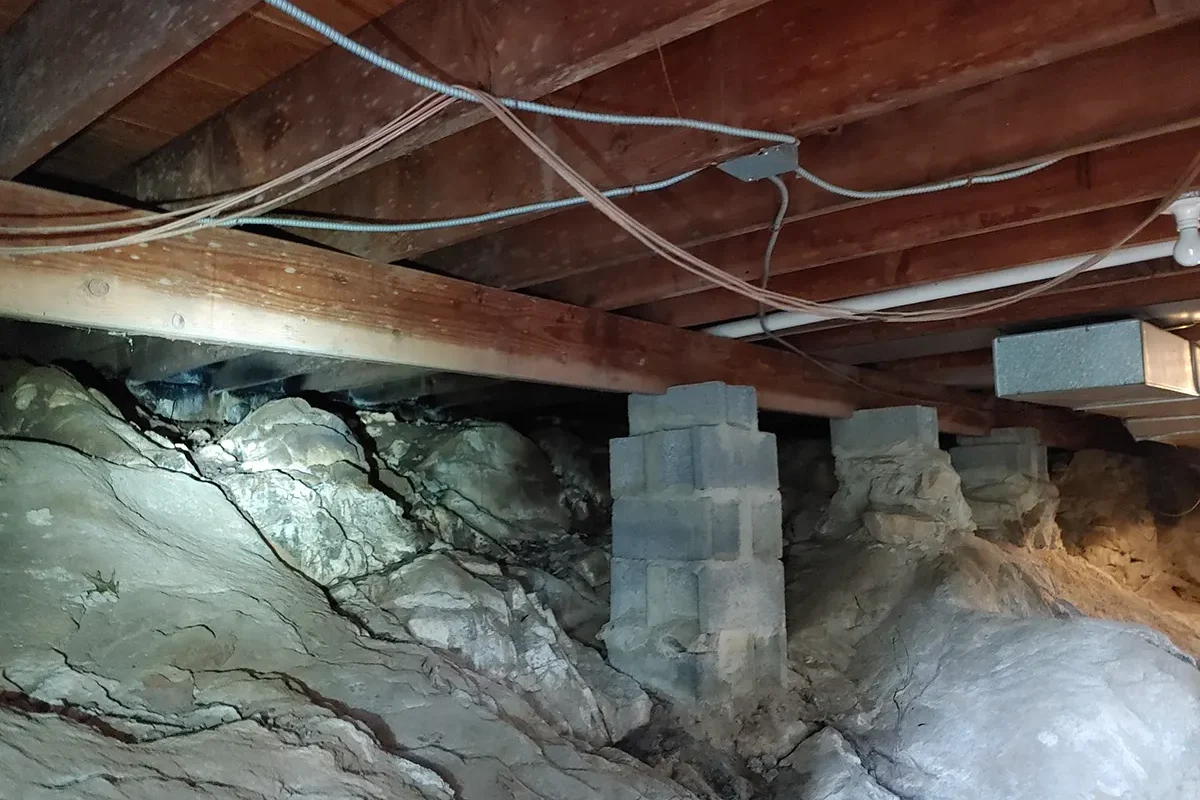
When the moisture driver is identified, confirmed, and corrected, crawl space mold becomes manageable instead of recurring. The difference is not in how aggressively something is cleaned, but in whether the underlying damp condition has been measured, addressed, and documented.
If you want that process handled with discipline, MasterTech Charlotte follows the same sequence outlined here: confirm the cause, correct the moisture condition, contain the work, and verify the result. The goal is not a quick visual improvement. The goal is a crawl space that stays stable because the conditions that supported growth have been changed.